


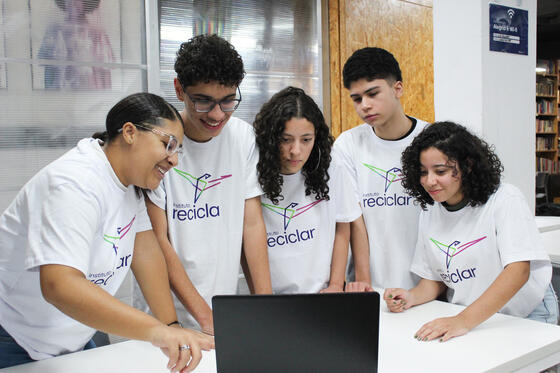
Instituto Reciclar reports 92% employability rate among young people in São Paulo
Instituto Reciclar reports 92% employability rate among young people in São Paulo
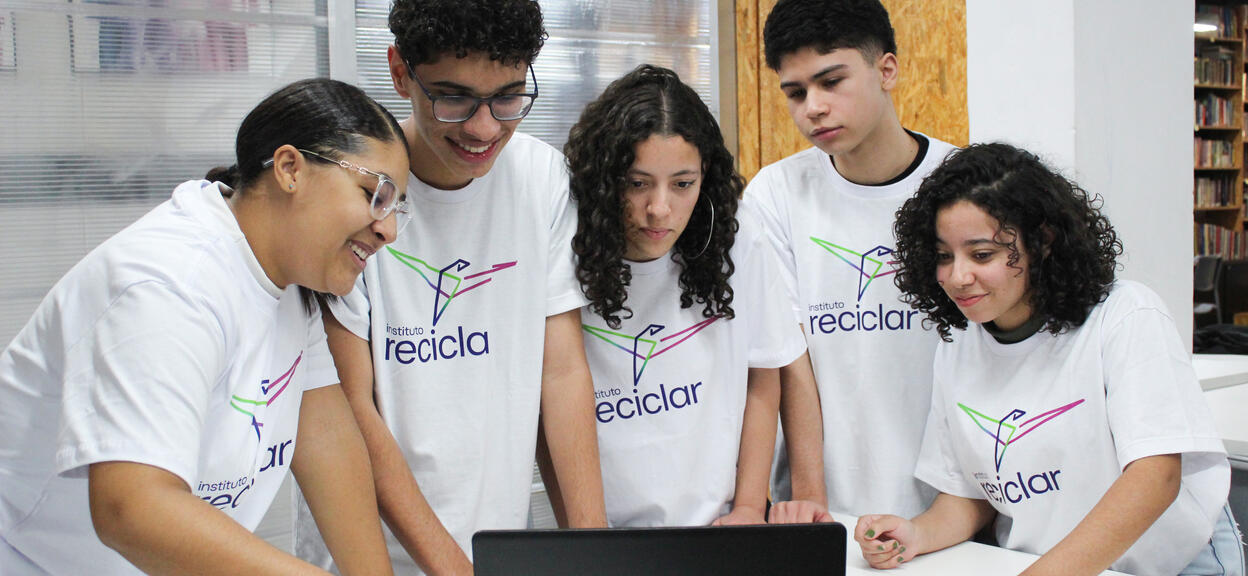
The program served 330 adolescents between 15 and 19 years old
Press contact - Latin America
Ana Caiasso
Press contact - Brazil, Chile and Argentina
Vinicius Riqueto
-
Economic inclusion program supported by the Alstom Foundation served 330 young people in 2025, impacting a 75% increase in family income
-
The Instituto Reciclar initiative strengthens the economic inclusion of young Black, mixed-race (69%) and women (61%)
-
The project registers significant advances in the development of socio-emotional skills, with an emphasis on proactivity (82.5%) and teamwork (81%)
São Paulo, April 9, 2026 – Instituto Reciclar, a social organization that works to empower and economically include vulnerable youth, announces the results of its program carried out throughout 2025 in São Paulo. The program, supported by the Alstom Foundation, served 330 adolescents between 15 and 19 years old, achieving indicators that exceeded initial projections and reinforce the effectiveness of the training model adopted by the institution.

"Partnerships like this one with the Instituto Reciclar demonstrate that consistent social impact is built over the long term, focusing on education, inclusion, and real opportunities."
Of the total number of young people served, 69% are Black and mixed-race and 61% are women, reflecting the Instituto Reciclar focus on expanding opportunities for groups historically underrepresented in the labor market. One of the program's main highlights was the 92% employability rate, above the 85% recorded at the beginning of the partnership in January 2025, demonstrating consistent progress in the professional integration of the participants.
The positive impact extended to the family context. In 2025, the program recorded an average increase of 75% in the family income of young people, a percentage significantly higher than the 40% observed previously, indicating greater economic stability and financial autonomy.
“The results achieved by the Instituto Reciclar in 2025 prove the value of structured and continuous partnerships. Supporting the training of vulnerable youth is not just a social action, but a concrete investment in building a fairer future for these young people. Strengthening socio-emotional skills is essential so that they not only enter the professional world, but consolidate themselves in it with autonomy and leadership,” says Carlos Henrique Lima, Executive Director of the Instituto Reciclar.
In addition to the quantitative results, the mapped socio-emotional skills showed improvements over the period. The skills with the greatest growth were teamwork, with an increase of 81%, and proactivity, which advanced 82.5%, being considered fundamental for the development of young people in the job market.
The results were supported by the Alstom Foundation, which financed the initiative, enabling the expansion of services and the strengthening of the Instituto Reciclar training activities. The partnership is part of the foundation's strategy to support projects focused on social inclusion, education, and employability in the communities where the Alstom group operates.
“Partnerships like this one with the Instituto Reciclar demonstrate that consistent social impact is built over the long term, focusing on education, inclusion, and real opportunities. Supporting projects like this is a concrete way to contribute to social mobility and the development of the communities where we operate,” says Suely Sola, general director of Alstom Brazil.
Alstom Brazil
Present in Brazil since 1955, Alstom actively participates in the development of infrastructure and mobility in the country, promoting social progress with respect for the environment. In the last fiscal year (2024-2025), the company's contribution to the Brazilian economy reached R$ 763 million in added value to GDP, of which approximately R$ 600 million refers to indirect impacts generated by its supply chain. During this period, Alstom's operations in Brazil were responsible for generating more than 5,800 direct and indirect jobs.
The Taubaté (SP) factory, inaugurated in 2015, has established itself as a center of excellence in the production of stainless steel passenger cars. In the last four years, the unit has received R$ 130 million in investments as part of the company's global growth strategy. In the last three years alone, more than 170 trains, equivalent to more than 940 cars, have been or are being produced at the unit for national and international projects. The unit was responsible for manufacturing 27 Citadis cars for the Rio de Janeiro Light Rail (VLT), delivered in record time for the 2016 Olympic Games. This project was the second in the world to operate with a 100% catenary-free system. Strategically located in an industrial hub, the factory is close to the Dutra and Carvalho Pinto highways, as well as the Port of Santos, the largest port complex in Latin America.
A leader in rail mobility in the Brazilian market, Alstom operates across all its product lines for rail transport, serving the main passenger transport operators in the country, in cities such as São Paulo (SP), Rio de Janeiro (RJ), Porto Alegre (RS), Recife (PE), Brasília (DF) and Belo Horizonte (MG). In addition to producing rolling stock, the company develops and supplies control and signaling systems — essential for rail traffic safety — which are also applied in mobility projects in other Latin American countries and around the world, such as South Africa, Argentina, Colombia, Chile, Ecuador, the United States, Mexico, Panama, Peru, the Dominican Republic, Romania, and Taiwan.
About Alstom Foundation
Established in November 2007, the Alstom Foundation supports and funds projects aimed at improving the living conditions and economic prospects of communities located near Alstom facilities and plants worldwide. All projects are submitted and supported by Alstom employees, who work together with specialized partners and rely on the support of the Alstom Foundation to generate a positive impact on the local environment. All projects are conducted in strong partnership with local or global NGOs with proven implementation capabilities on the ground.

