


70 years of innovation and mobility in Brazil
Seven decades ago, Alstom began its journey in Brazil with a clear purpose: to drive the country’s development through technology, engineering, and innovation. From the first energy projects to leadership in sustainable transport solutions, our history has been marked by achievements, partnerships, and a commitment to the future.
Celebrating 70 years means recognising the essential role we have played in building a more connected and efficient Brazil, reaffirming that we remain ready for the challenges of tomorrow’s mobility.

1955 – The first steps: Energy, infrastructure, and heavy mechanics
Alstom’s history in Brazil began in Taubaté in 1955 with the construction of the Mecânica Pesada S.A. factory.
The industrial unit was inaugurated with the mission of producing essential equipment for national infrastructure, such as concrete mixers, turbines, and marine engines, which supplied major Brazilian projects, including hydroelectric plants like Itaipu, Tucuruí, and Paulo Afonso.
1970 – Entering the transport market
In the 1970s, as the country invested in urban mobility, Alstom expanded its operations to the rail and metro sector.
Our journey began with the creation of Empresa de Tração Elétrica (ETE), which participated in landmark projects such as São Paulo Metro Line 3, in partnership with Cobrasma.
The big leap came in the 1980s with the localisation of signalling systems and the development of technologies such as ATO, ATC, ATS, and ATP, essential for the safe and efficient operation of urban trains. The incorporation of CMW Equipamentos by GEC-Alsthom, and later by Alstom, consolidated our technological leadership and expanded our portfolio of solutions, including onboard systems, operational control centres, and modern interlocking systems.
In 1997, we took over the Mafersa plant in Lapa, reviving a historic factory and transforming it into a global reference in stainless steel car production. The unit was responsible for mobility projects in Brazil and several countries worldwide, such as Rio de Janeiro Metro, São Paulo Metro, and exports to the United States, Chile, India, and South Africa.
In 2015, Alstom completed the sale of its energy business to General Electric. Since then, the company has been exclusively dedicated to the development and delivery of sustainable mobility solutions, including high-speed trains, advanced signalling systems, and comprehensive railway services.

2015 – From Taubaté to the world
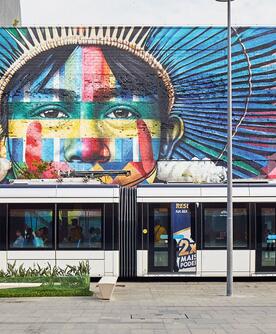
One of the major milestones in this journey was the construction of the Taubaté factory, inaugurated in 2015, initially to serve the VLT Carioca, a pioneering project for the Rio de Janeiro Olympic Games. Taubaté became a center of excellence, receiving new investments and expanding its operations to national and international projects. The assets from Lapa were later transferred to this unit.
In 2022, the factory underwent a significant expansion, tripling its built area and reinforcing Alstom’s commitment to sustainable mobility. After investments of more than R$130 million over the past four years, the unit now produces trains for transport systems in countries such as Taiwan, Romania, Chile, and several metropolitan lines in São Paulo.

Crossroads Brazil - Building on 70 years of transformative rail
Read moreJoining forces: Acquisition of Bombardier
In 2021, Alstom took a decisive step to consolidate its global leadership: the acquisition of Bombardier Transportation.

At the Hortolândia unit in São Paulo, the first Innovia monorail trains for Line 15-Prata were produced, along with cutting-edge signalling systems that make urban mobility more efficient and safe, committed to more sustainable cities.
This union brought a legacy of innovation and technology to Brazil, expanding our ability to deliver complex projects and reinforcing our commitment to sustainable solutions. With integrated teams and shared expertise, we continue to transform urban and rail mobility, connecting journeys and destinations across the country.
The future of mobility
Celebrating 70 years means looking back with pride and forward with determination. Today, Alstom Brazil is a benchmark in sustainable mobility solutions, connecting cities and people with technology, innovation, and commitment. Our purpose is clear: to keep transforming the way the country moves, making transportation more efficient, cities smarter, and people’s lives more connected.
Our history is built on connections of people, stories, and movement. Keep this journey with us!

