Crossroads Brazil - Building on 70 years of transformative rail
Crossroads Brazil - Building on 70 years of transformative rail
The indelible imagery: Copacabana, the Christo Redentor, Sugarloaf Mountain, Carnival, samba, bossa nova, football, the Amazon.
The complicated reality: a massive urban (at around 91%, one of the highest in the world) and ageing population. A highly diverse society with similar issues facing other large nations, like wealth disparity and security concerns. Home to perhaps the most intense environmental flashpoint in the world. And an unimaginable wealth of natural resources.
Complexity rivalled only by an even greater potential - this is Crossroads Brazil, a crucible where all the challenges of growth in a contemporary global context come together to demand novel solutions. Where transformation is inevitable.
Our Sustainability Vice President Véronique Andriès spent time here early in her career as a researcher. “It has continental dimensions, constantly growing urban centres, and crucial logistical needs for economic development,” she explains.

“Brazil can become a true leader in sustainable mobility in Latin America: its energy matrix is predominantly renewable, its human capital is technically advanced, and its vast territory demands integrated transportation solutions.”
Feliz aniversário - to our operations, to climate action
2025 marks the 70-year anniversary of Alstom in Brazil. But that’s not the only reason we’re focusing on Brazil this month.
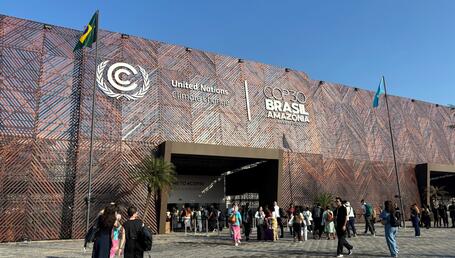
Belém is hosting COP30, the United Nations annual conference on the climate crisis. As one of the few voices from the transportation sector in attendance, we intend to make a firm case to key global decision-makers: Investment in decarbonised transport can help member nations move towards their sustainability goals in quick, dramatic fashion and can make their growing urban centres more prosperous and resilient.
Let’s have a look at our work in Brazil, at how we’re tackling urban mobility, investing in local talent, and leading the sustainability charge, regionally and globally.
Investment in decarbonised transport can help member nations move towards their sustainability goals in quick, dramatic fashion and can make their growing urban centres more prosperous and resilient.
Urban case study - São Paulo
São Paulo embodies three trends that make Brazil Alstom’s most strategic Latin America rail infrastructure partner: a rapidly expanding urban market, strong demand for sustainable mobility and an increasingly structured public-private partnership environment, perfect for unlocking investment.
Our current production numbers tell the story of a city where market demand for rail is ready to explode. Even today, Alstom rolling stock, signalling and services enable the mobility of over 6.5 million Brazilians.
And every day, 160,000 of them use Sao Paulo’s L15, the first operational monorail in Latin America. The L15 features the sleekly designed Alstom Innovia™. The line strategically connects residential areas in the city’s east zone to the city centre, reducing travel time by 50%.
Innovia monorail allows for minimal urban impact - running above city traffic, it uses less land space. It also offers energy efficiency and full life-cycle serviceability, not to mention fully automated driverless technology and a lightweight supporting infrastructure that’s fast to assemble. It’s a perfect example of the urban mobility innovation that will be so vital to the resilient cities of the future.

Sao Paulo’s L15 is the first operational monorail in Latin America

Citadis tram serving Rio’s Porto Maravilha district - a fully catenary-free integrated system
But the future won’t wait: so we’re leading Sao Paulo public transport modernization with projects like the iconic Line 6-Laranja, operated by Linha Uni. It’s the largest urban mobility project in Latin America. It will have extraordinary social impact once completed, connecting the north zone to the city centre and at least seven institutions of higher education. This will reduce a 90-minute auto or bus commute to just 23 minutes.
The ViaMobilidade Lines 8 and 9 is another exciting project, where Alstom will invest R$1 billion into Latin America’s first ETCS (European Train Control) Level 2 system. Its continuous, wireless, real-time radio communications revolutionises control and operational safety. It's cutting-edge technology that will put São Paulo on par with major city peers worldwide.
A bit further into the future lies Line 14, the Ônix Project. Once completed, this €3 billion megaproject will represent a network larger than the massive Tren Maya in Mexico. Full definition of the project is expected this December.

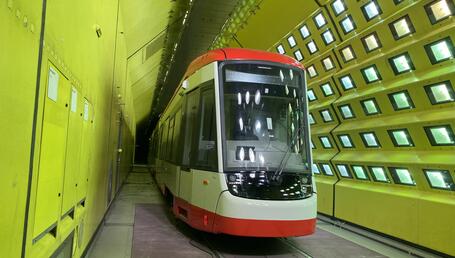
Our factory in Taubaté, Brazil

Taubaté has established itself as a global centre for stainless steel train manufacturing excellence.
Taubaté – a symbol of our unique relationship with Brazil
Market competition is vital. It drives the innovation that will make future systems more resilient and life more prosperous. We’re confident that our 70-year history in Brazil and our global experience in signalling, energy efficiency and digitalisation give us a competitive advantage.
But what truly sets us apart is this: Alstom is the only rail manufacturer with its own production facility in Brazil.
Celebrating its own ten-year anniversary this year, our Taubaté plant has the capacity to not only service the Brazilian market, but also to export. Trains manufactured here are now in operation in Chile, Romania and Taiwan. In fact, Taubaté has established itself as a global centre for stainless steel train manufacturing excellence.
In November 2022, Alstom announced the expansion of the Taubaté factory, tripling its built area from 20,000 m² to 60,000 m². The €14 million investment was driven by the signing of six national and international contracts, totalling more than 170 trains (around 940 cars).
We’ve discussed climate resilience. But our solid industrial base (Taubaté plus our Agua Branca site, which manufactures signalling components for all our Latin America operations) and strong domestic supplier network (78% from Brazil) also give us market resilience and stability, reducing dependence on imports and ensuring competitiveness even in potentially chaotic business scenarios.
Rail can impact sustainability targets now
“The COP30 Action Agenda must… support the acceleration of the energy transition worldwide, including… transitioning away from fossil fuels in energy systems,” states COP30 President André Corrêa do Lago.
We’re excited to participate in COP and promote our decarbonising transport message to key decision-makers. But the environmental crisis calls for action. We’ve made tremendous strides. We can - and will - do more.
COP30 leaders in Belém must back solutions that can deliver immediate and large-scale climate and development benefits.
Rail can move the needle on environmental impact today, unlike aviation and other sectors where breakthroughs remain decades away. And rail is already clean. There are technologies that exist today to make it even cleaner (including electric, battery and hydrogen).
It’s not a nascent technology. Scaling rail offers countries a proven way to rapidly decarbonise NOW. It can give communities cleaner, faster and more inclusive transportation options while spurring economic growth.
With decisive public and private action, rail can become the backbone of sustainable mobility.
With decisive public and private action, rail can become the backbone of sustainable mobility.
In the end, it’s best to look at Brazil as a microcosm of the world, a laboratory and testing ground where ineluctable pressures give rise to their very solutions. Perhaps that’s why we’ve partnered so closely with the Latin nation over the decades - our answers here address similar questions posed all over the world.
We’re eager to learn more about how global leaders plan to commit to COP30 climate solutions, convinced that rail must play a pivotal role.