Alstom and BVG celebrate the entry into commercial service of Berlin’s new extra-long tram
Alstom and BVG celebrate the entry into commercial service of Berlin’s new extra-long tram
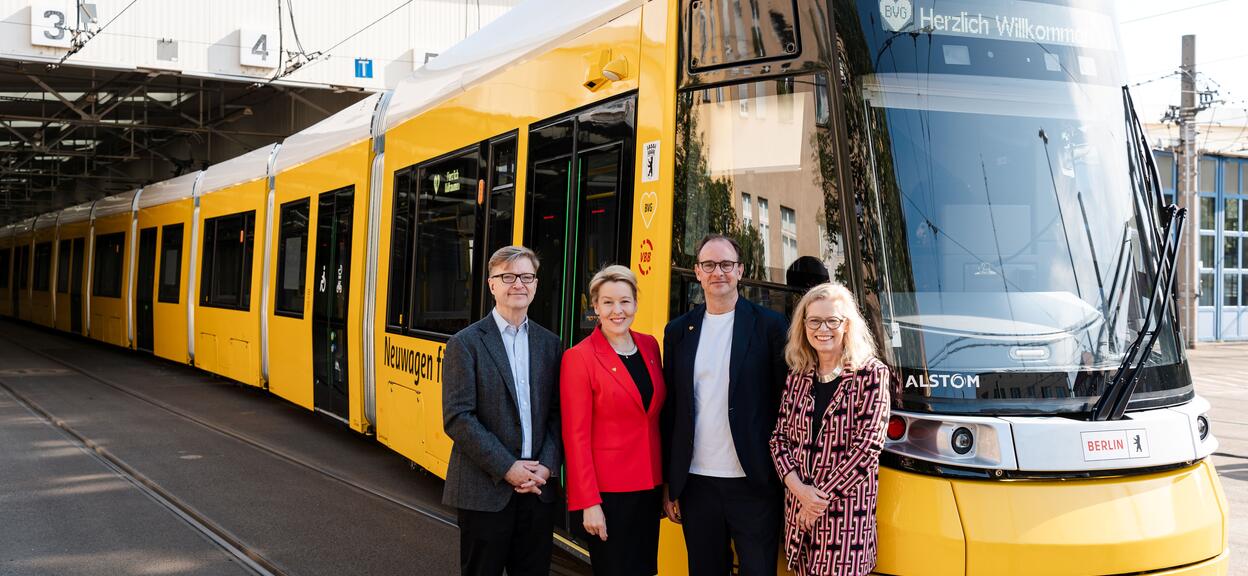
From left to right: Christoph Klaes (Alstom), Senator Franziska Giffey, Henrik Falk (BVG) and Senator Ute Bonde (Copyright: BVG/Florian Buendig)
-
The BVG continues to renew its fleet
-
50-metre tram provides greater capacity on the busiest route
-
Passengers benefit from more space and even greater accessibility
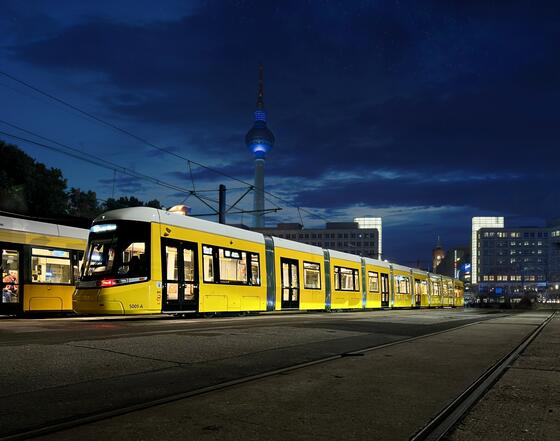
Berlin’s new, extra-long tram is now in service. Today, Wednesday 15 July 2026, the first ‘Urbanliner’ tram at the BVG officially entered regular service following final field trials. At 50 metres in length, the trams significantly outshine Berlin’s previous models. Their first route is, unsurprisingly, the M4, which has been one of the busiest lines on Berlin’s tram network for years. Passengers were invited to experience the new space for themselves during the official maiden journey. To mark this special occasion, Senators Franziska Giffey and Ute Bonde also accepted the invitation to the Weißensee depot.
Prior to the official handover for passenger service, minor adjustments to the infrastructure in the Alexanderplatz area were required as part of the approval process. Following structural recalculations, two additional supports were installed in the underground tunnel to provide extra safety against a higher calculated load scenario. All the announced measures were implemented quickly and successfully.
“The BVG makes the capital a place that millions of people can experi-ence and enjoy living in. We at Alstom are proud that the new Urbanliners now play a central role in this”
“As the BVG team, we acted swiftly and purposefully to overcome the final hurdles. All the conditions are now in place to bring a new dimension to Berlin’s public transport,” said BVG’s Chief Executive Officer Henrik Falk. “With these new vehicles, we are ensuring that, following the underground, the tram fleet is also well-equipped for the coming decades. What we are currently achieving is by no means a matter of course: rarely have so many forward-looking projects been launched simultaneously as they are today. The Urbanliner is yet another visible sign that we are consistently investing in modern vehicles and high-performance infrastructure for Berlin.”
Franziska Giffey, Senator for Economic Affairs, Energy and Public Enterprises: “Berlin is growing – and the BVG is growing with it. The Urbanliner is a building block in this development. The new trams are setting new standards simply through their size: more space for Berliners and visitors to our city, greater comfort and full accessibility. We are thus making a targeted investment in local transport services on Berlin’s busiest route – the M4. In doing so, we are keeping pace with the growth of our metropolis, Berlin. The Urbanliner represents a Berlin of the future that ensures mobility for all.”
Ute Bonde, Senator for Mobility, Transport, Climate Protection and the Environment: “The new Urbanliner trams are more than just a technical upgrade. They are investments that make a difference. And with space for more than 300 passengers, they represent a form of mobility that is geared towards people’s needs.”
Alongside the start of passenger service, further deliveries of the ‘Urbanliner’ trams from the manufacturer Alstom are now beginning. The fleet is set to grow to around 15 vehicles before the end of this year and is expected to double again by 2028. The remainder of the 65 Urbanliners currently on order are then expected to follow by 2030.
As is customary, approval was granted on a route-by-route basis. The new trams are currently approved for use on Berlin’s busiest tram route, the M4. In the future, they are also intended for use on other routes.
High performance, greater comfort, and accessibility
The new trams can accommodate more than 300 passengers. On the M4, they are replacing the GT6 trams, which are coupled to form double trains and are gradually being taken out of service. Passengers can enjoy a whole range of ‘extras’ on the new trams. Inside, a new lighting concept creates a pleasant atmosphere, with the colour temperature switching between cool and warm white depending on the time of day and season. At the doors, green and red LED strips clearly indicate when passengers can board and when they should wait. The new chassis design noticeably improves ride comfort and reduces vibrations.
“The BVG makes the capital a place that millions of people can experience and enjoy living in. We at Alstom are proud that the new Urbanliners now play a central role in this,” said Christoph Klaes, Vice President Customer Management for Central and Northern Europe at Alstom. “This new generation of trams combines high performance with greater comfort and accessibility. It has been specifically designed to meet Berlin’s growing mobility needs.”
A fully accessible tram
The important issue of accessibility also played a major role in the development. Large multi-purpose compartments provide space for passengers using wheelchairs or walking frames. Comfort seats at a height of 51 centimetres are available for people with reduced mobility, whilst extra-low seats (40 centimetres) cater for children and people of short stature. Handrails with a “golf ball texture” at the doors help blind and visually impaired passengers to find their way. An additional gap filler now also facilitates barrier-free boarding at stops with left-hand boarding.
For the first time, a BVG tram will also operate entirely without exterior mirrors. Instead, there is a camera system that improves the driver’s rear view in all situations. There are virtually no blind spots left. In addition, an assistance system has been installed that warns of obstacles in the vehicle’s path.
In response to changing demand patterns, the Urbanliner is the first type of Berlin tram to operate without mobile ticket machines. The BVG is thus adapting to its passengers’ purchasing behaviour. The vast majority of users now buy tickets digitally or already hold a ticket such as the Deutschlandticket. At the same time, however, the BVG has also significantly expanded the sales network along the M4 line. The number of sales points there has been increased by around 70 per cent.