The future started half a century ago
The future started half a century ago
Every morning at 6 am, you board the metro from your home near the Punggol coast. You rely on it to get to Singapore’s central area. Like many commuters, you choose the train for its affordability and the reliability of the city’s well‑established public transport network.
As you descend into the platform, you recall a headline from last night: “The train of the future will be automated.” What does that even mean? But your thoughts are interrupted by the loud beep of closing doors. You don’t even try to catch the train that’s about to leave. They come so often nowadays. You’ve stopped thinking of them as “scheduled.” They just… arrive.
You settle in and pull out your phone: driverless metros have existed since the 1980s! You check your line: North East Line. Fully automated. You’re sitting in a driverless train right now.
You walk through the long open corridor of the train, all the way to the cabin in the front. No driver - just a windscreen and the tunnel ahead. You return to your phone. As you scroll, maps, timelines, and entire lists of systems unfold - city after city, line after line, all running automated trains just like this.
It hits you: the train of the future is here.


Why automate?
The reality is that demand for transportation keeps rising, but tracks don’t multiply. Automation is an extremely effective way to unlock more performance from the infrastructure we already have. By combining sensors, AI, and advanced train control, automation makes rail smarter, faster, and more efficient.
Automated systems can safely run trains much closer together. More frequent trains mean up to 30% increased capacity on the line. And greater punctuality - automation excels at adapting in real-time, network-wide, to changing conditions.
Automatic trains also use up to 45% less energy. Such digital intelligence optimises driving patterns in ways that manual operation simply cannot compete with.
And finally, automation is a blessing for passengers, as all this means smoother rides, fewer disruptions and more reliability.
In short: we automate because rail needs to do more, do it better, and do it sustainably. And automation is the only way to achieve that at scale.
Automation is an extremely effective way to unlock more performance from the infrastructure we already have. By combining sensors, AI, and advanced train control, automation makes rail smarter, faster, and more efficient.
Automate what, exactly?
Automation is not a product you slap on a train. It’s a way of deciding who - or what - takes care of each part of the journey.
Depending on the needs of our customers, passengers and cities, we have four different grades of automation, where GoA0 is fully manual and GoA4 is fully automatic. Between those points sit layers of assistance that smooth out speed, timing and station stops, removing variability and raising reliability.
As the train stops at a station, you watch passengers get on and off. Even with fully automatic trains, it’s not that complex, right? What’s the big deal? Platform screen doors, a closed tunnel and some sensors on the front…
Well, not exactly.

Closed environments
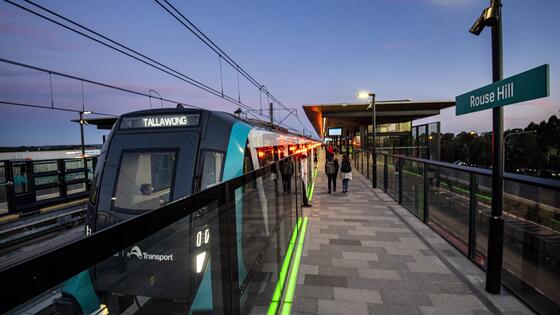
The “right level” of automation depends entirely on the environment. In the network you’re riding, full automation feels almost natural. So is the case of many metros, monorails and Automatic People Movers in cities such as São Paulo, Montreal, Sydney, Istanbul, and many others.
These run in what we call a closed environment. The tracks are used by one specific train, with no other vehicles or pedestrians on the tracks. A predictable environment. So, we automate here to reduce delays, increase frequency, which helps us move more people, and move them faster. And it consumes less energy.
Open environments
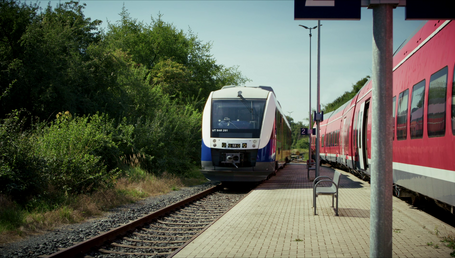
But regional, commuter, high-speed and light rail have different challenges: level crossings, pedestrians, and plenty of other trains running on timetables.
In a Munich depot, imagine the quiet before service begins. A commuter train waits for its first trip of the day. But instead of someone climbing into the cab, an operator in a control room wakes it up remotely. A live camera view shows the tracks ahead. Instructions are sent over a secure connection; the train inches forward, connects to another carriage, moves again, and positions itself for the morning run. This remote‑operation trial, carried out by Deutsche Bahn and Alstom, reduces walking time for staff and speeds up turnarounds before passengers ever step aboard.
Now imagine a regional train threading its way through towns and over roads and paths. In Germany, the ARTE project - short for Autonomous Regional Train Evolution - is teaching existing regional trains to “see” the world around them. Cameras and smart software help them read signals, recognise what’s ahead and keep a smooth, steady rhythm. If something unexpected appears, an operator can instantly take over. Run together with LNVG, TU Berlin and the German Aerospace Center (DLR), ARTE shows that automation doesn’t only belong on new metro lines. It can emerge on tracks that people already use every day.
Discover the ARTE project here

Now think of a tram running at street level. Pedestrians, cyclists, road vehicles, mixed traffic... Our Obstacle Detection Assistance System (ODAS), a vision-based, three‑camera driver‑assistance system that continuously scans the track, detects and tracks obstacles, assesses collision risk in real time, warns the driver, and can trigger automatic braking. It works day or night, in all weather, and in mixed or segregated traffic. With 1,200+ units across 12 fleets, it leads the market for new builds and retrofit solutions.
COMPAS (Collision Prevention Assistance System) builds on ODAS by adding overspeed prevention. Using tram location and track geometry, it enforces safe speeds through curves and complex sections - helping prevent derailments, rear‑end collisions and accidents in the busiest urban environments.
Systems that keep going, and going, and going…
Building resilience into a rail system starts with understanding the people and places it serves. As rail architects, we shape our solutions around the needs of the city - its growth, its challenges, and its long‑term vision.
Globally, the pattern is consistent. In Hamburg, commuter trains are being upgraded for semi-automatic train operation so they can run more closely together and with steadier timing on tracks that are already full. The train handles precision driving, while the driver oversees doors and the line ahead.
The result: fewer delays, more trains per hour and a smoother, more energy‑efficient service.

The S-Bahn trains will be equipped with the European Train Control System (ETCS] and modern ATO technology for automated train operations. Copyright Deutsche Bahn AG | Oliver Lang

Sao Paulo will implement the first European Train Control System (ETCS) Level 2 in Latin America | Copyright Via Mobilidade
In São Paulo, lines 8 and 9 are two of the busiest commuter lines being modernised - so trains can run more reliably in some of Latin America’s most intense traffic conditions. Trains can stay closer together and recover from disruptions faster.
And in Manila, new digital systems on a major corridor will help trains run at steadier intervals - creating a more reliable, higher-capacity backbone across a growing region.
Different places, different pressures, but the same idea: trains that use digital intelligence to run more smoothly, recover faster and make better use of the tracks. It’s the practical next step toward more resilient rail, and therefore more resilient cities.

Smooth operator
You snap back to Singapore as the train pulls into your station. You exit, then the platform screen doors slide shut behind you. They won’t reopen until the next train arrives… Here it comes!
Walking out of the station, it occurs to you that everything you just experienced is now ordinary. Millions of people around the world rely on automated trains every day without thinking twice. And that’s the point. Automation is meant to be transparent, moving you safely, reliably, and efficiently, without friction. For passengers, all that matters is the service it provides.
Your commute ends here, but our journey toward more resilient, intelligent rail systems is far from over.