Why do some journeys feel... right? Designing experiences
Why do some journeys feel... right? Designing experiences
The millions of men and women who ride in Alstom rolling stock each day may not consciously analyse the many details shaping their journey. But they feel them.
“I was on the metro a couple years ago with a friend. I actually worked on the design for that specific train,” explains Passenger Experience Director, Anne Bigand. “While I was explaining some of the finer points of the design, a passenger seated across from us said, "Excuse me. You designed this train? I just love riding it.”
"Why,’ I asked. ‘What about it do you like so much?’”
"I don’t know, exactly," the woman said. "It’s just so comfortable. It feels like home."
To Anne, this is the ultimate compliment.

Omission as design: absence makes the passenger grow fonder
What concrete, intentional design details were behind the passenger’s feeling of “home”?
Anne, her friend, and the passenger were sitting in a set of two-by-two seats facing each other. So far, nothing special. But the seats were connected in an uninterrupted arc together to the side wall to create a unified alcove. This is what made the area so cozy, warm, and welcoming.
This feeling of home is also the result of a design carefully conceived for passengers. All the mechanical elements that you can usually find in the vicinity of seating - locks, screws, hatches, joints, air vents - are very discreet, if not invisible. Nothing disrupts the sensation of being settled into a protective, intimate alcove. The finishing touch of this well-crafted passenger experience lies in the choice of physical touchpoints: the window ledge, where the arm naturally comes to rest, and the seat cushions, which have been designed to accommodate a variety of sitting styles.
The science behind the experience
For a passenger to have a decent experience, we must meet their basic needs. Reliability, punctuality, and comfort are reflected in the functionality and efficiency of the solutions, the ease of cleaning, the ergonomic aspects, and so on. Go a bit further; large windows let the light in and make the space inside the train friendlier and clearer.
But what moves passenger experience from merely basic to memorable?
A memorable passenger experience relies on perceived quality, on how a passenger’s senses receive an environment. To achieve this quality perception, we must address three ascending levels of emotion.
At the foundational level of Passenger Experience, an environment must soothe a passenger. This is accomplished by ensuring quality interiors that answer the functional, physiological, and psychological needs of each passenger. Moving upward, an experience must satisfy a passenger: adding design balance and the strategic elements that will enhance the experience even more. Finally, good PX works to delight passengers, offering pleasant surprises and beautiful details.
Fun fact regarding perception: the brain is stimulated and excited in the exact same way when an environment is irritating as it is when an environment is delightful. So, designers just as importantly must take caution against filling the passenger environment, even with satisfying elements, to prevent sensory overload. A lot of areas have improved perceived quality when passengers don’t notice the design at all!

Keeping things neutral in Switzerland
Neutrality is a way of designing environments that feel immediately calm and trustworthy, especially in a dense, fast‑moving city. For our Flexity trams in Zurich, neutrality became the guiding principle for passenger experience, to reassure passengers and to elevate everyday travel.
The experience begins with space (or precisely, with the perception of space). Zurich’s Flexity trams can accommodate 20% more passengers than the previous fleet, yet they never feel crowded. Wide gangways, a fully flat low floor and an open interior layout create a sense of volume that passengers feel the moment they step inside. Sightlines extend from one end of the vehicle to the other, offering total visual control of the environment.
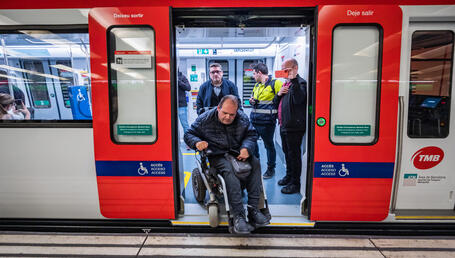
That freedom of movement is essential for everyone, but it is transformative for passengers with reduced mobility. Enlarged PRM areas allow wheelchair users to circulate comfortably without isolating them from the rest of the space. Movement flows naturally around them.


Comfort here is both tactile and spatial. The wooden seats define the interior without drawing attention to themselves. Smooth, clean, and ergonomically shaped, they invite passengers to sit naturally. Visually light and easy to wipe down, they bring subtle warmth while supporting operational efficiency. Most passengers never know why the space feels right; it simply does. Thermal comfort follows the same logic. An energy‑optimised, heat‑pump‑based air‑conditioning system maintains a stable, pleasant climate throughout the tram.
Light is one of the most powerful neutralizers of stress, and in Zurich’s Flexity trams it is used with precision. A large, continuous window - like a transparent ribbon wrapping the vehicle - floods the interior with daylight. Inside, this creates openness and visual continuity with the city outside. From both inside and out, passengers can anticipate boarding and alighting, which naturally improves passenger flow and reduces dwell time.
Behind all this lies advanced technology, deliberately kept out of sight. Obstacle detection system (remember ODAS?), low noise levels inside and outside the vehicle, discreet USB sockets allowing passengers to recharge devices, robust materials chosen to age gracefully, each detail contributes to an experience that feels neutral, balanced and dependable.
The rounded front end gives the tram a friendly, recognisable face, one that city residents have embraced with pride as part of their cityscape.
Home is where the passenger experience is
Alstom operates in more than 70 countries. Every day, the systems that we deliver and maintain move more than 100 million people.
We want both numbers to grow.
As rail increasingly becomes the default mode of transport in urban and regional mobility, expectations evolve accordingly. To passengers, trains are just like every other environment they move through during the day: their home, their workplace, a café, a public space. Comfort and emotional well-being are no longer optional. Whether the journey be long or short, we give our passengers experiences that they trust, enjoy and even forget (because everything simply works), and we help rail fulfill its potential as the backbone of sustainable mobility.