Innovation at Alstom: unlocking the potential of rail, responsibly
Alstom exists to make rail the backbone of a more connected, resilient, and inclusive world. Innovation is how we stay ahead - anticipating global shifts, embracing complexity, and transforming challenges into opportunities for everyone we serve. And for ourselves, as a global company with a massive industrial footprint, we innovate to ensure we are always operating at peak efficiency and sustainability.
Focus where it matters.
We always innovate with a clear purpose. Every fresh idea, every breakthrough technology, every new solution brought to market, is designed to help unlock rail's full potential, to move people and economies forward. We focus our innovation efforts on four interconnected areas: making rail smarter, making rail greener, embedding resilience within rail, and designing experiences for passengers.

Smarter rail
We accelerate digitalisation - deploying AI, automation, and data-driven tools to make operations seamless, safe, and efficient. From predictive maintenance to autonomous trains, we harness digital technologies to create ever more efficiencies at the system-of-systems level.
- On busy urban metro systems, our Urbalis Fluence signalling system utilizes Computer-Based Train Communication (CBTC) to allow trains to “talk” to each other directly instead of waiting for commands from trackside equipment. Resulting headways as small as 60 seconds increase transport capacity by up to 20%. And lifecycle energy consumption can be reduced by 30%.
- HealthHub is our cloud-based solution that corrals hundreds of real-time messages from rolling stock and infrastructure and shapes them into meaningful results that drive predictive maintenance. This has resulted in service downtime reductions of up to 30% and scheduled inspection intervals stretched to five months instead of three.
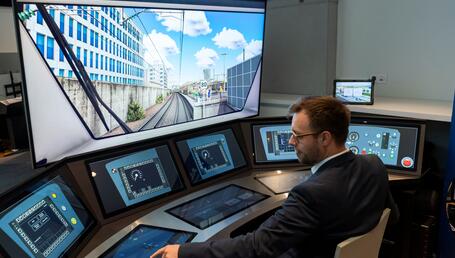
- In testing at the current time, our ARTE (Autonomous Regional Train Evolution) project will decisively support the digitalisation of the German rail network through automated train operations (ATO) that use the European Train Control System (ETCS) - without the need for additional trackside equipment. The project also includes implementation of RTO (Remote Train Operations) technology that would allow a “driver” to control the train at a distance using a simple tablet.


Greener mobility
We target net zero across the full rail-lifecycle - clean propulsion, Eco-Design, lightweight and recycled materials that make rail ever cleaner. Our commitment: sustainable operations, maximum energy efficiency, and minimal environmental footprint.
- Alstom's Hesop is a cutting-edge reversible power substation designed to facilitate traction voltage supply to a network while recovering braking energy from vehicles. On suburban train networks in Napoli, for example, Hesop captures over 99% of recoverable braking energy and redirects it into the power grid for resale or to use for power station facilities, including escalators, lighting, and ventilation. The recovered energy results in 20% fewer substations needed for new lines.
- Green re-tractioning: with the Hydrogen Internal Combustion Engine (H2 ICE), Alstom is working on a plug-and-play solution enabling the conversion of diesel shunting locomotives to hydrogen propulsion. After conversion, the locomotive no longer emits CO2, saving up to 3,000 tonnes of CO2 over a remaining service life of 15-20 years. A prototype started test operations in the summer of 2025.


Embedding resilience
We engineer railways to withstands shocks - environmental, societal, digital - ensuring they can resist, adapt, and recover. Resilience is a central feature of performance, and railways must be a dependable investment for society.
The industry standard is that trains should be able to operate between -25 °C and +45 °C. We go further. In Canada and Nordic countries, we winterize rolling stock to withstand temperatures as low as -40 °C (and even -50 °C for locomotives). When things heat up in Riyadh, cooling systems aboard the metro are designed to operate even as external temperatures soar to +58 °C - even if power supply is cut off.
We invest in local and regional resources to withstand geopolitical upheavals and global crises. In Upstate New York, our Avelia Liberty project used 95% domestically sources components. We've also invested $590 million into creating a sustainable and diverse US supply chain that includes more than 180 suppliers across 29 states. On the other side of the equator in Brazil, our plant in Taubaté is the rail industry's only South American production facility. It too utilizes a 78% domestic supply chain.


Designing experiences
We shape every rail solution for real people - accessible, modular, and adaptable to changing needs. We co-create with partners, customers, and communities to ensure rail works optimally for those who benefit from our systems.

It's the world's only double-decker high-speed train and offers a 35% greater rider capacity than the competition. But that's only part of the Avelia Horizon story. Its design allows operators to easily add or remove passenger cars depending on traffic evolution. The passenger cars themselves are designed to allow section customisation. In fact, the interiors of the passenger cars can be reconfigured in record time.


Alstom has the only in-house Passenger Experience department in the industry and brings together 550 dedicated experts who focus on configurable architectures, inclusive interiors, advanced digital connectivity and the highest levels of comfort for passengers.
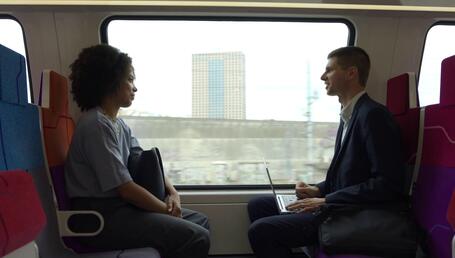
For the new RER NG (Next Generation) commuter train in Ile-de-France (Paris), designers actually polled local residents when choosing seating fabric and colours to create an interior with emotional resonance and community connection.